When deciding whether a new door should open inwards or outwards, it is essential to consider the advantages and disadvantages of both options.
Inward-opening doors vs. outward-opening doors
The choice between an inward-opening and an outward-opening door will depend on the installation location and whether it is for a commercial or residential door setting. In this blog, we provide a comprehensive overview of when to choose an inward or outward-opening door, how the type of door influences this decision, and the specific requirements for residential and commercial & industrial door environments.
| Consideration | Inward Opening (Swing In) | Outward Opening (Swing Out) |
| Best For | Residential front doors, Hallways | Commercial exits, Public buildings |
| Security | Hinges are protected inside | Harder to "kick in"; requires security hinges |
| Weather | Better protection from wind/rain | Can be caught by strong wind gusts |
| Safety Code | Not ideal for rapid evacuation | Mandatory for fire exits (Life Safety Code) |
Should exterior doors open in or out?
Typically, it is preferred for exterior doors to swing inward to improve security and shield the door from harsh weather. When a front door opens inward, its hinges are located inside the house, preventing potential intruders from manipulating the hinges to access your home. On the other hand, an exterior door that swings outward is quite challenging to forcibly open. Although the hinges are located outside, they are equipped with non-removable pins, making them less susceptible to tampering by burglars.
If you stroll down your local high street, you'll observe that public establishments often feature outward-opening exterior doors. This design ensures the safety of individuals in case evacuation from the building becomes necessary. Ideally, fire escapes should be equipped with fire doors that open outward to facilitate an efficient and safe evacuation route during a fire emergency.
Do External Doors Have to Open Inwards?
No. While exterior doors typically open inwards, we believe outward-opening front doors enhance security, particularly with our steel options, such as fire proof steel door, making it harder for intruders to break in. It’s also worth considering where you would need to save space in your home. For instance, you might prefer patio doors to open outward to help save space inside your home.
Should interior doors open in or out?
Interior doors typically swing inward within a house. This design choice is often made since most interior doors are located off hallways, and inward-swinging doors help conserve space in the hallway. Outward-opening doors can disrupt the flow of a home's layout as people move about. Additionally, an interior door that swings outward may infringe upon usable space.
Front Doors
Choosing between inward or outward-opening front doors is a matter of personal preference. Both options offer security against intruders. However, tests show that outward-opening steel doors provide better protection, as they are harder to break through and better withstand the elements.
Garage Entry Doors
The garage doors would benefit from opening outward to save space within the garage. It also provides better protection from burglars who may attempt to force entry through the garage.
Inward vs. Outward – You decide
When choosing exterior doors, numerous factors need to be taken into account, and personal preference often plays a significant role. Security is likely the top priority to think about, particularly in residential settings, while the safety of others would be paramount if the door is being installed in a bustling shop or office.
Security Analysis: Are Outward Opening Doors Safer?
One of the most common myths in home and building security is that inward-opening doors are inherently safer because their hinges are "hidden" inside. While this holds some truth for standard residential wooden doors, the narrative changes entirely for high-security steel doors.
For professional security installations, outward-opening (swing-out) doors often provide superior resistance against forced entry for several reasons:
Fire Safety & Evacuation Requirements (Life Safety Codes)
In the world of commercial and industrial architecture, the direction of a door swing is strictly governed by life safety codes such as NFPA 101 and the International Building Code (IBC).
The primary rule is simple: Any door serving as an exit for a high-occupancy area must swing in the direction of travel (outward).
The Anti-Crush Principle: In an emergency evacuation (such as a fire or gas leak), a panicked crowd will naturally push forward. If a door opens inward, the pressure of the crowd pressing against it will make it impossible to pull open. An outward-opening door ensures that the momentum of the crowd helps, rather than hinders, the escape.
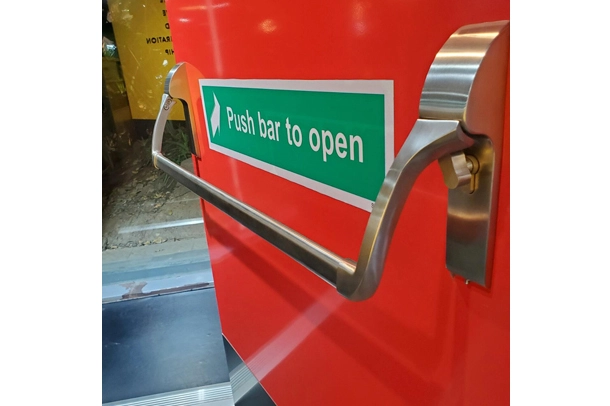
Panic Hardware Compatibility: Outward-opening fire doors are designed to work seamlessly with panic bars (crash bars). These allow occupants to unlock and open the door in a single motion by simply leaning against the bar, even in low-visibility conditions.
Occupancy Thresholds: Generally, any room with an occupant load of 50 or more is legally required to have outward-swinging exit doors.


 English