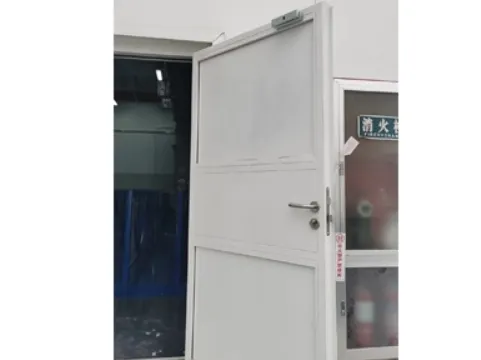
In the high-stakes world of industrial safety, the margin for error is non-existent. In facilities where volatile chemicals are processed, combustible dust is present, or high-pressure systems operate, the risk of an explosion is a constant, underlying reality. To mitigate these risks, safety engineers rely on a specialized category of protective equipment: the explosion proof door. Designed to withstand extreme pressure, high-velocity fragments, and intense heat, these doors are the unsung heroes that prevent a localized accident from turning into a total facility catastrophe.
The Physics of an Explosion
To appreciate the design of an explosion proof door, one must first understand the nature of the threat. An explosion is not merely a flash of fire; it is a rapid release of energy that creates a supersonic shockwave. This shockwave exerts a peak overpressure on any surface it encounters.
However, the destructive power of an explosion comes in two phases. The positive phase is the initial outward blast that crushes structures. The negative phase is the vacuum that follows, which can actually pull doors off their hinges or cause a building to collapse inward. An effective explosion proof door must be engineered to withstand both the initial impact and the subsequent rebound, ensuring the seal remains intact throughout the entire event.
Materials and Structural Integrity
Standard commercial doors are typically made of hollow metal or wood, which would disintegrate instantly in a blast scenario. In contrast, explosion-proof systems are constructed from heavy-gauge structural steel plates, reinforced with internal stiffeners.
The frame is just as critical as the door itself. While the door leaf absorbs the impact, the frame must transfer that massive energy load into the surrounding reinforced concrete or steel structure. This requires specialized anchoring systems and heavy-duty hinges that can support the immense weight of the door while remaining functional after a blast. If a hinge shears or a bolt snaps, the door becomes a projectile, exacerbating the danger rather than preventing it.
The Blast-Proof Shutter
While traditional swing doors are the standard for personnel access, modern industrial layouts often require protection for larger openings, such as loading docks, conveyor passages, or equipment bays. In these scenarios, a traditional heavy steel door may be impractical due to space constraints or the need for frequent automation.
This is where advanced solutions like the explosion proof doors from SEED GREEN come into play. Unlike a standard rolling door, a blast-rated shutter is engineered with reinforced slats and high-strength guide rails designed to stay seated in the track even under intense pressure. SEED GREEN’s technology allows for a more flexible application of blast protection, providing a retractable barrier that offers high-level security without the footprint of a massive swing door. These systems are particularly valuable in hazardous zone compartmentalization, where they can be integrated into the facility’s fire and explosion detection systems to close automatically when a threat is identified.
Testing and Certification Standards
The performance of an explosion proof door cannot be left to guesswork. In the United States and internationally, doors are rated based on blast load analysis, usually measured in pounds per square inch (PSI) and the duration of the pressure (measured in milliseconds).
Common standards include those set by the American Society of Civil Engineers (ASCE) and the Department of Defense (DoD). A static load test measures how much weight a door can hold, but a dynamic test is required to simulate the actual impact of an explosion. During these tests, sensors measure permanent set (how much the door bent) and fragmentation (whether any pieces flew off). For a door to be truly explosion-proof, it must meet a No Break or Low Hazard rating, meaning that while the door may be permanently deformed after the blast, it remains in the frame and prevents the passage of fire and debris.
Vital Applications Across Industries
The necessity for explosion-proof protection spans a wide range of sectors:
Petrochemical and Refineries: These are the most common sites for blast doors, protecting control rooms where operators monitor volatile processes.
Pharmaceuticals and Laboratories: Many chemical synthesis processes involve reactive gases that pose a risk of localized flash explosions.
Military and Defense: Protecting munitions storage and personnel bunkers from both accidental and intentional blasts.
Grain and Sugar Processing: Often overlooked, dust explosions are a major risk in these industries. Explosion-proof barriers help contain a dust flare-up to a single silo or processing unit.
Power Plants: Particularly those using hydrogen cooling systems or natural gas turbines.
Maintenance
Like any life-safety equipment, an explosion proof door requires regular inspection. Over time, the heavy weight of the door can cause hinges to sag, or seals to degrade. In a blast scenario, even a gap of a few millimeters can allow high-pressure jetting of hot gases to enter the protected space. Utilizing high-quality components ensures that the hardware is built for longevity, but facility managers must still commit to annual checks of the door’s alignment, hardware integrity, and automated closing mechanisms.
In the modern industrial world, we cannot always eliminate the risk of an explosion, but we can control its consequences. The explosion proof door serves as the ultimate guardian of human life and infrastructure. By investing in precision-engineered solutions and adhering to rigorous testing standards, organizations can ensure that when the unthinkable happens, their final line of defense holds firm. Protection is not just about the strength of the steel; it is about the engineering excellence that turns a simple barrier into a life-saving system.


 English